
Cloud computing has transformed the way businesses run. Its advantages, like mobility, cost savings, & access to leading hardware, give companies moving to the cloud a distinct complete advantage. With almost 50 percent of corporate data now in the cloud, there’s no better time to make the move.
Multi-cloud deployment lets companies take full advantage of the flexibility, scalability, & cutting-edge technology that large cloud providers give. Meanwhile, hybrid cloud solutions give companies a higher degree of ownership over specific elements of their IT infrastructure.
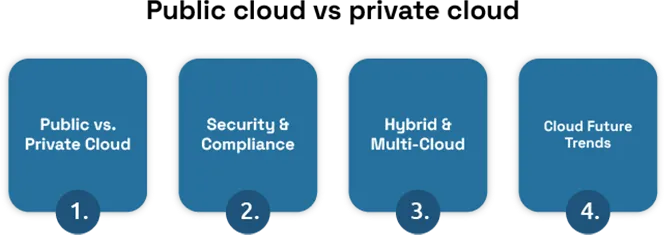
Public cloud vs private cloud
The difference between public cloud & private cloud infrastructure is who owns, controls, and maintains the physical compute resources.
What is a public cloud solution?
Public cloud environments offer their range of computing resources over the internet. Their servers often give resources to many different companies. They are typically hosted in large data centers and offered by prominent public cloud providers, such as Microsoft Azure, Amazon Web Services, & Google Cloud Platform.
What is a private cloud solution?
Private cloud infrastructure solutions, on the other hand, are usually on-premises, privately hosted services used by one organisation. They are generally held behind company firewalls & dedicated to specific or specialist workloads.
By understanding private & public cloud services, it’s possible to choose between multi-cloud & hybrid cloud strategies.
What is Hybrid Cloud?
A hybrid cloud computing architecture uses a combination of two or more different cloud environments. It combines at least one private cloud solution with at least one public cloud resource. A hybrid cloud deployment must use at least two different types of cloud infrastructure.
The most common hybrid cloud strategy will combine on-premises or hosted resources owned & controlled by a company with public cloud resources from a third-party provider. The company can then use orchestration to cover workloads hosted in these different environments.
Hybrid cloud vs multi-cloud: What are the key differences?
To compare multi-cloud and hybrid cloud services, it’s best to begin with the physical architecture, & then look at the effects.
Architecture
Hybrid & multi-clouds have a fundamental difference in their architecture. A hybrid cloud environment comprises a mixture of private & public cloud services, while a multi-cloud model with two or more public cloud services.
The main difference is that hybrid cloud users own & cover a private cloud resource as part of their cloud infrastructure. This is usually hosted in-house, in on-premises data centres, or on dedicated servers in third-party data centres. The private aspect then syncs with public cloud workloads to create an overall business solution. Multi-cloud systems use only public cloud services.
Pricing
A company employing a hybrid cloud model can often invite higher costs. This is especially true when the private cloud resource is hosted on-premises – the company would purchase, manage, & maintain that resource.
Public cloud services do not require that initial spend. As such, multi-cloud solutions using public cloud resources are much more cost-effective to deploy & manage. Taking advantage of the huge buying power of public cloud customers gives multi-cloud users access to leading technology on a more affordable basis.
Availability
Multi-cloud environments are designed for high availability. The service levels & guarantees offered by large cloud vendors mean that public cloud resources give companies business-critical uptime. If one resource goes down, it can simply switch to another.
Hybrid cloud resources have some degree of management from the owner. Should the private resource go down, it will require maintenance, & possibly cause significant downtime should no backup resource be available.
Data Storage
One of the biggest benefits of hybrid cloud computing is that the private cloud resource lets companies operate their data storage. Often, it’s used to store critical, regulated, sensitive data. This can then connect to public resources, which handle less-sensitive tasks.
Of the hybrid cloud advantages & disadvantages, data storage can be one of the most significant depending on your industry. It gives compliance for critical data, but is usually a finite resource with uptime and disaster recovery concerns. Meanwhile, a multi-cloud solution offers almost infinite storage space, backups, and disaster recovery possibilities.
Security
One of the most apparent hybrid cloud benefits is that companies control who can physically access their private cloud hardware. This can be desirable in highly regulated industries. With multi-cloud solutions, companies do not control who can access the physical network, although it is typically kept behind layers of robust security.
Online, multi-cloud solutions offer cutting-edge security. The state-of-the-art systems make automation, access controls, encryption, & general security simple to configure & manage. In a hybrid environment, it is up to the company to configure & control online access to its private cloud resource.
Flexibility
Flexibility is where multi-cloud solutions shine. A business can choose exactly which resources it needs, selecting the provider with the ideal services. While hybrid cloud users can choose their public cloud service provider, they are more limited with their private cloud resources.
Multi-cloud architecture also allows companies to scale as needed. These can be quickly deployed. There’s also no vendor lock-in, allowing companies to choose the right supplier for each task instead of being limited to a single cloud provider. A hybrid cloud resource may also have configurations or needs that limit choices or impact your cloud migration.
Conclusion:
Hybrid & multi-cloud strategies give businesses the flexibility to use the power of multiple cloud platforms while maintaining control of their entire critical workloads. By adopting a well-planned approach, organizations can improve performance, & optimize costs, positioning themselves for greater agility and long-term success in a changing digital world.
Did you know?
Despite the rapid adoption of cloud computing, enterprise data centers’ large-scale, on-premises facilities for IT infrastructure remain a critical part of an organization’s tech stack and are evolving to meet modern security, performance, and compliance demands.
FAQ
1. What is the difference between a hybrid cloud and a multi-cloud?
A hybrid cloud combines on-premises infrastructure with one or more public clouds, while a multi-cloud strategy uses multiple cloud services from different providers without necessarily integrating with on-premises systems.
2. Why should businesses adopt a hybrid or multi-cloud strategy?
These strategies offer flexibility, reduce vendor lock-in, enhance disaster recovery, and allow businesses to optimize workloads based on performance and cost.
3. What are the main challenges of managing hybrid and multi-cloud environments?
Common challenges include data integration, security management, compliance, and maintaining consistent performance across platforms.
4. How can organizations ensure security in a hybrid or multi-cloud setup?
Implementing unified security policies, using robust encryption, and employing centralized monitoring tools can help maintain strong security across all environments.
5. What tools help manage hybrid and multi-cloud data centers effectively?
Tools like cloud management platforms (CMPs), automation frameworks, and orchestration solutions help streamline operations, monitor usage, and control costs across diverse environments.
