
Know about Edge Computing and Why It Matters Today?
Edge computing is a technology in which systems process data near the data source, including sensors, IOT devices, or local edge computing servers, which is not just a centralized cloud or remote data center. This change greatly reduces delay, allows fast reactions, & improves the performance of the system.
Traditionally, organizations leaned on cloud computing data centers that processed information in remote locations. But with real-time applications like autonomous vehicles and industrial automation, sending data back and forth to the cloud is no longer ideal. Edge computing enhances the speed and reliability of services by complementing cloud-based data centers and integrating tightly with data center virtualization for cloud computing environments. The approach provides resource optimization and reduces the load on the centralized network.

Key Drivers Behind the Growth of Edge Computing
The exponential growth of IoT devices is one of the reasons why edge computing is gaining recognition. These connected devices generate a huge amount of data that must be processed with minimal delay—something edge computing manages effectively by bringing analytics to the source. Furthermore, edge models are closely linked to data centres in cloud computing frameworks, which improves data accessibility without compromising performance.
Another key driver is the global deployment of 5G networks, providing ultra-fast connectivity and low latency that perfectly suits virtual data center in cloud computing environments. also, AI and ML tools are increasingly deployed at the edge, enabling autonomous systems and smart applications that no longer need to constantly “call home” to a centralized server.
Many tech companies are investing heavily in infrastructure, including data center automation software and cloud colocation services to support this transition. Market analysts project that the international edge computing market will increase from USD 11 billion in 2022 to over USD 100 billion by 2030, showing just how important this technology is becoming across all industries.
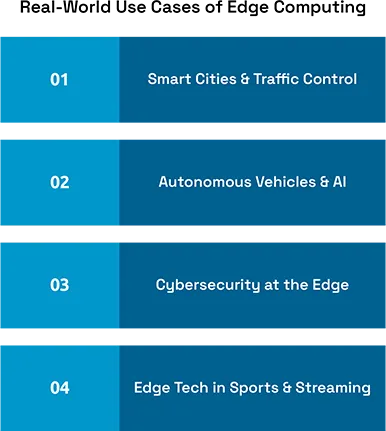
Real-World Use Cases of Edge Computing
Edge computing is already making a tangible difference across various industries. In healthcare, for instance, edge-enabled devices assist in monitoring patients remotely and processing health metrics in real-time. This is particularly critical in underserved or rural areas where cloud connectivity may be limited.
In retail, smart sensors connected to cloud colocation environments are used for dynamic pricing, customer tracking, and inventory automation, enabling quick decision-making and improving the in-store experience. These tools frequently depend on integrations with data centers and data center automation tools to optimize back-end operations.
Manufacturers use edge-based systems to power predictive maintenance, analyze machine health, and prevent equipment failure. These applications often intersect with data center virtualization in cloud computing, allowing manufacturers to scale compute resources quickly when needed.
The automotive sector, particularly autonomous driving technology, heavily depends on edge computing for instant decision-making, such as detecting road conditions or rerouting. Telecom companies are also using edge computing to optimize traffic by offloading data to nearby data centers in cloud computing frameworks, enhancing user experience through reduced latency.
Strategic Implications for Businesses and IT Leaders
Adopting edge computing gives a wide range of strategic benefits to businesses. This reduces delay, increases the uptime, & improves data protection by reducing the transmission of sensitive data in long networks. Companies can also cut the bandwidth cost by processing data locally which low low-cost compared to centralized cloud computing data centers.
However, the implementation of edge strategies involves rethinking infrastructure. Many businesses are transitioning toward colocation cloud solutions or hybrid cloud models that blend centralized cloud with local edge computing nodes. This shift often demands investment in data center optimization techniques, automation tools, and robust cybersecurity practices.
From an IT leadership perspective, success with edge computing also means developing skills internally to manage distributed infrastructures. Data centers can ensure more scalable and manageable methods for digital changes with sellers providing the data center services, cloud collection pricing and advanced data center automation software.
The Future of Edge: Trends, Challenges, and Opportunities
Looking ahead, AI at the edge is poised to be a game-changer. Embedded models allow the edge devices to make intelligent decisions without the need to depend on the cloud. It will run the development of edge-native applications, designed to run in particularly decentralized environment & will work originally with cloud-based data centers or virtual data centers.
Challenges persist, however. These include managing distributed edge nodes, ensuring interoperability across platforms, and securing devices against cyber threats. There’s also a growing need for global standardization and governance frameworks that align with enterprise compliance.
Despite these hurdles, edge computing’s future is bright. With increasing investments, such as Microsoft AI data center spending, and continuous evolution in data center and cloud computing integration, edge computing is expected to play an important role in reshaping enterprise IT. Today, the business of yesterday that hugging this change will be in efficiency, agility and customer experience.
Did You Know?
According to IDC, worldwide spending on edge computing is projected to reach $274 billion by 2025, growing at a CAGR of 15.6% from 2021.
FAQs
1. What is edge computing in simple terms?
Edge computing is the processing of data at or near devices or where the data is produced, rather than transmitting it to an External cloud or central data center. This response speeds up time and reduces network load.
2. Why is edge computing growing so rapidly?
The increase of IoT devices, the expansion of 5G, & the need for live data processing are key drivers. Industries need faster, localized services that traditional cloud computing cannot always provide.
3. What are some common use cases of edge computing?
Cases of use include real-time health monitoring, autonomous driving systems, smart retail analytics, future maintenance in manufacturing and network adaptation in telecommunications.
4. How does edge computing benefit businesses?
This reaction improves in time, reduces bandwidth cost, increases data privacy, and supports real-time decision making. It also allows more efficient use of resources in data-intelligence operations.
5. What are the main challenges of adopting edge computing?
Challenges include infrastructure investment, security management, scalability, and integration with existing IT systems and cloud platforms.
Did You Know?
According to IDC, worldwide spending on edge computing is projected to reach $274 billion by 2025, growing at a CAGR of 15.6% from 2021.
