Achieving Sustainability Goals in Data Center Operations
The problem of the expansion of demand in computational resources and the decreased compliance with various global sustainability targets are becoming the major challenges for data centers with the growth rate of the digital economy. As the demand for power increases with AI computing, cloud computing, IoT, and 5G, the demands for an efficient data center balancer—power to performance, power to user, and power to green—have come a long way.
This paper aims to establish the ways through which data center operators are capable of meeting this challenge while still being environmentally conscious. Through such an insight, the adoption of new technologies, and preparing for future development, the leaders of data centers can attain the objectives of technological advancement together with sustainability.
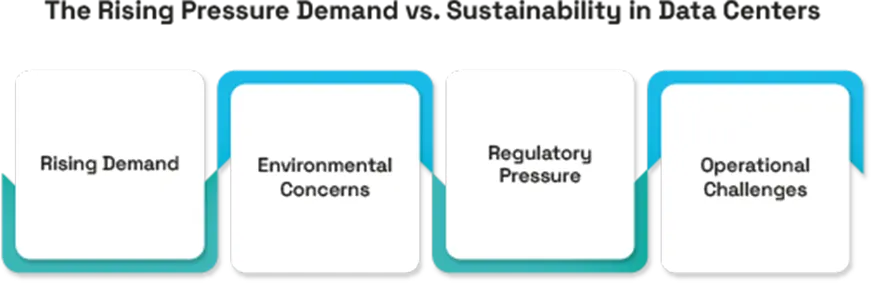
The Rising Pressure: Demand vs. Sustainability in Data Centers
This is because there is a rise in requirements for data center workloads caused by the new technologies, such as artificial intelligence and machine learning, that heavily rely on computational power. As a result, many facilities are getting close to their power and cooling capacity issues. According to the data, it was stated that data centers currently utilize 1%-1.5% of electricity consumption all around the world, and it is estimated that this rate will increase with a rate of less than 3%-3.5% in the year 2030 if the change is not made. This implies that if demand is not well-regulated or managed, it results in unsustainable operation in case there is no strategic data balancer for the data center.
On the other side, the governments, investors, and consumers have gone wolfish for environmentally friendly operations. They are becoming increasingly stringent, mostly due to the EU and California regulatory bodies that demand that data centers disclose information on emissions and their plans to minimize them. It has become imperative for organizations to address the sustainability aspects of data centers since sustainability has become a necessity in the business world today. In the EU’s bid to achieve the ideal of net-zero emissions within operating sites cannot be exclusive to electricity usage, hardware disposal, or construction materials.
Optimizing Cooling: Smart Strategies for Energy Efficiency
Air conditioning systems rank among the most energy-hungry infrastructures in a data center. Specifically, standard air cooling is not sufficient to handle higher-density deployments and any applications involving high-powered GPUs. Newer approaches like direct liquid, on-chip coolant, and immersion cooling lower the overall power consumption and boost thermal efficacy. These technologies enhance higher computing density, further reduced through air conditioning in line with sustainability data centers.
Moreover, measures such as hot aisles and cold aisles can also be employed to improve the airflow and decrease the cooling load. Free cooling, whereby fresh air or water is used to cool equipment, is also widely used, especially where the environment is cold. Another and final implementation of AI in the data centers is the power controls, as it brings efficiency in the energy used for cooling in line with the workload and cuts wastage, and enhances the performance of the data centers.
Power Management and Renewable Energy Integration
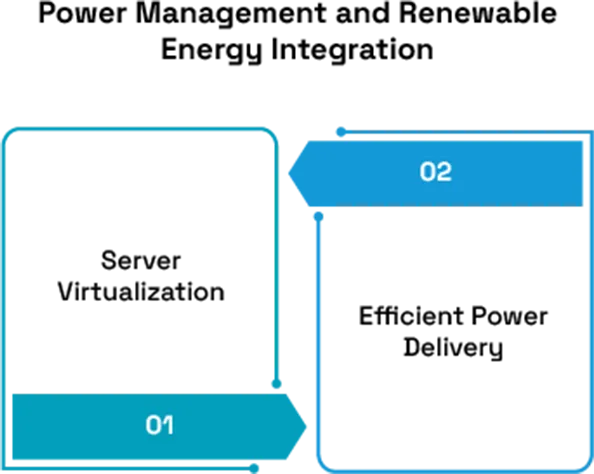
Governance of power demands is very important to ensure that it meets the demand within sustainable measures. Such measures as virtualization of the server, condensation, and others make the number of functional machines decrease, thus, the energy consumption as well. There are some mechanisms, such as Dynamic Voltage and Frequency Scaling (DVFS), that enable saving power while delivering varying workloads in the server. These complement power distribution units, or PDUs, delivering power smartly throughout the cake racks.
Overall, the longest-term solution and basis for any sustainable future is the shift to renewable energy sources. There is a rising trend of using PPAs and green tariffs that connect operators with electricity from wind, solar, and hydropower facilities. Some are even expanding solar farms or local battery energy storage to reap independence from their resources. These actions make facilities key players in the sustainability of the data center movement and decrease reliance on fossil energy sources.
Smart Monitoring and Reporting: A Key to Continuous Improvement
Advanced DCIM tools in the current world keep records of PUE, CUE, and WUE to different power details or as granular as the airflow detail or temperature, among other indicators. These metrics enable operators to have real-time reviews of inefficiencies of the used-to processes so as to work closely towards improving on the resources that are used in the operations. It may also include features for notifying in the case of detected patterns of irregularities—it can be used to prevent problems before they occur and save energy.
Besides, the operational benefits obtained from detailed reporting include compliance with the environmental legislation. For the operational participants who have to abide by the increasing pressure from the governments in terms of sustainability reporting, automatic report-creating tools help them address the expectations from the stakeholders and contribute to the international initiatives towards sustainability. Monitoring is no longer an option; it has become an important paradigm to implement any effective data center balancer.
Future-Proofing with Innovation and Collaboration
If you want to achieve sustainable data centers, it is about innovation and creating the right alliances. A current example of how energy costs might be minimized with the help of a particular technological approach is edge computing, which implies carrying out processing at the edges, thus alleviating the load on facilities. Low-power chip architectures and the use of light instead of poison to get energy for the machines are also helping in green operations.
Equally important is collaboration. Indeed, partnering with sustainable suppliers, becoming a member of the industry associations, and adhering to international standards increases effectiveness. Reducing service delivery emissions, managing IT assets by correctly disposing of e-waste, creating data center modularity, or adopting hybrid renewable energy, sustainability can bring all stakeholders together and become everyone’s goal. But it is at the grassroots that the job of building true sustainable data center environments takes place at last.
Conclusion: Leading the Way in Sustainable Data Center Operations
Data center organizations require both performance in the current digital age and care towards the planetary platform on which they depend. Adding appropriate operational tech positively accelerates the data center, thereby empowering the operators to balance between demand and sustainable energy.
It’s high time now that organizations wake up to the fact that the pressures that exist in the environment and operating theaters are real. The time has come to embrace the concept of the sustainability data center— the facility that supports but also protects the digital future and the planet.